CTET SST Study Material: Ultimate 284-Page NCERT e-Book by Sikhoai
CTET SST free PDF 2026 with NCERT-based notes and pedagogy
CTET SST Study Material
Preparing for the Central Teacher Eligibility Test or CTET is a massive task that requires the right direction and authentic study material. For many aspirants the Social Studies or SST section is the biggest challenge because it covers a vast syllabus ranging from ancient history and geography to modern teaching methods and pedagogy. If you are looking for a way to score high marks in this section you have come to the right place.
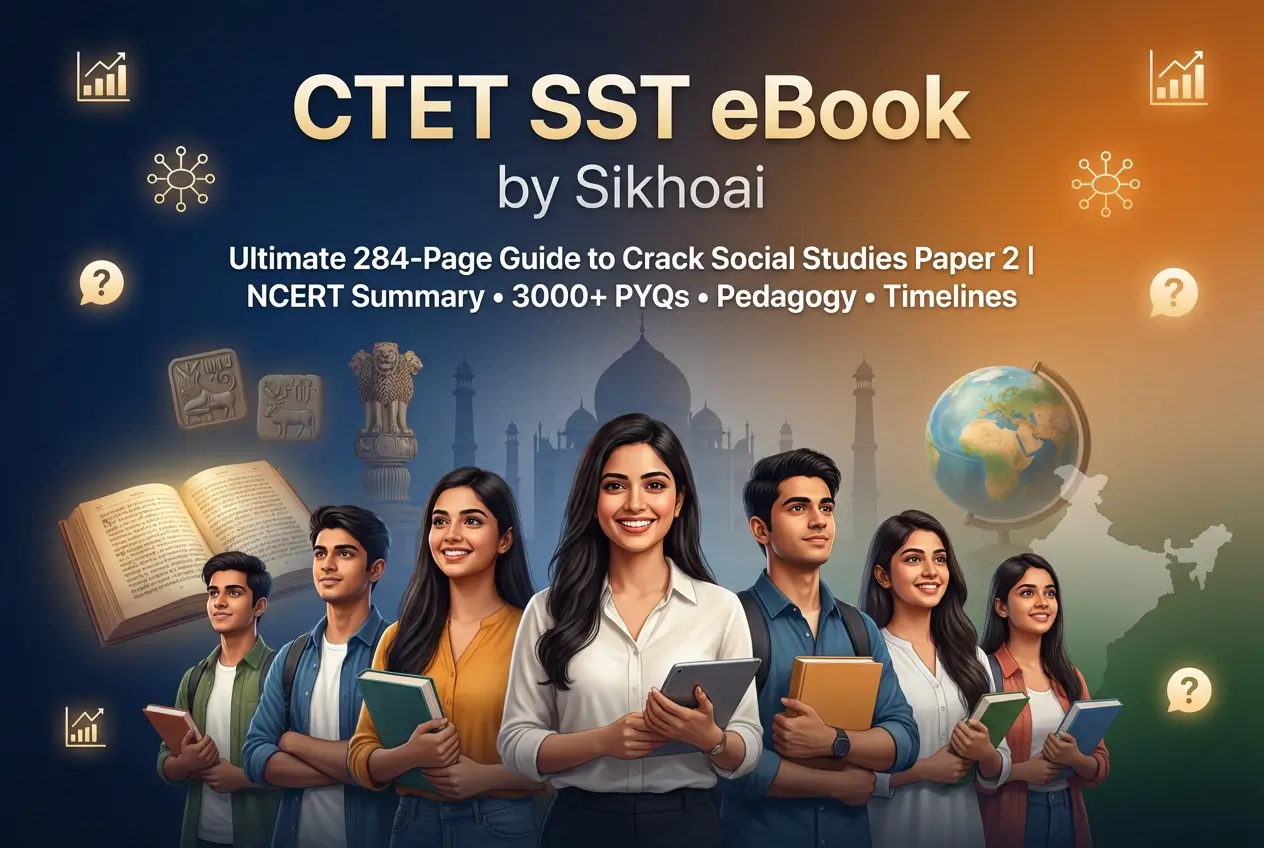
We understand that studying from multiple heavy books can be confusing and time consuming. Often students get lost in thick textbooks without knowing which parts are actually important for the exam. That is why we have created a specialized solution for you. We have launched the CTET SST E BOOK by Sikhoai which is a comprehensive 284 page document designed to cover every essential topic. Since it is impossible to solve all the questions from such a long PDF here we have provided a deep look into what you will find inside.
This 284 page ebook is based strictly on the NCERT curriculum ensuring that you get the most accurate and authentic information available. We have uploaded this PDF on Google Drive so you can easily download it and start your preparation today.
Proof of Quality: Real Questions from Our eBook
To show you why this ebook is a must have for your 2026 preparation let us look at some important objective questions included in the file. These questions are frequently asked in the CTET exam and require deep conceptual clarity rather than just simple memorization.
1. Ancient Administration: The Gupta Period
Ancient Indian administration is a favorite topic for CTET examiners. Our ebook provides detailed explanations for even the most complex terms to ensure you never lose a mark.
Question: The term ‘Pratham Kulika’ in the Gupta period stands for?
(a) Chief Judicial Officer
(b) Chief Banker
(c) Chief Merchant
(d) Chief Craftsman
Correct Answer: (d) Chief Craftsman
Explanation from our PDF: In the Gupta era the word Pratham Kulika was used for the Chief Craftsman. It is important to know other administrative terms too such as Mahadand Nayak for the Chief Judicial Officer and Sarthavaha for the Chief Merchant. The first great ruler of the Gupta dynasty was Chandragupta I. Our ebook covers all such administrative titles in a simple list format making it easy for you to revise just before the exam.
2. Ancient Manuscripts: The Rigveda Birch Bark
Understanding how our history was preserved is key to scoring well in the history section of CTET Paper 2.
Question: Where was the birch (Bhurja) bark found on which the Vedic prayers (Suktas) of the Rigveda were written?
(a) Kashmir
(b) Maharashtra
(c) Bihar
(d) Bengal
Correct Answer: (a) Kashmir
Explanation from our PDF: This specific birch bark was discovered in Kashmir. Interestingly about 150 years ago this bark was used to print the Rigveda for the very first time. Before that it was preserved as a manuscript for centuries. Today this precious manuscript is safely preserved in a library in Pune Maharashtra. Our study material provides these interesting historical facts that make learning history feel like a story rather than a burden.
3. Civilization and Technology: The Harappans
Many students get confused about the metals used by early civilizations and often mark the wrong age.
Question: The “Harappans” belonged to the:
(a) Bronze Age
(b) Copper Age
(c) Brass Age
(d) Iron Age
Correct Answer: (a) Bronze Age
Explanation from our PDF: The Harappan civilization is one of the oldest in the Indian subcontinent and is categorized as a Bronze Age civilization. They mastered the technology of mixing copper and tin to create bronze which they used for tools weapons and ornaments. It is a common trap to think they used iron but our ebook clearly explains that the Iron Age started much later in India.
4. Geography and Astronomy: Planets and Moons
The geography section of CTET often tests your knowledge of our solar system with very specific data.
Question: Which of the following is not matched correctly regarding planets and the number of moons?
(a) Mars – 02
(b) Jupiter – 53
(c) Uranus – 52
(d) Neptune – 13
Correct Answer: (b, c, and d are all technically incorrect based on the latest astronomical data)
Explanation from our PDF: This question is designed to test if you are keeping up with updated knowledge. Based on the NCERT and latest research from agencies like NASA Jupiter has a much higher number of moons than 53. Similarly Neptune actually has 14 moons instead of 13. Mars remains consistent with 2 small moons named Phobos and Deimos. Our ebook keeps you updated with these tricky facts that older books often miss.
5. Understanding Social Reality: Labor Chowk
The Civics or Social and Political Life section requires an understanding of real world issues and daily struggles of the working class.
Question: What is a “Labor Chowk”?
(a) A place where forced labor is practiced
(b) A place where laborers are sold
(c) A place where daily wage laborers gather in search of work
(d) A place where laborers are given night shelters
Correct Answer: (c) A place where daily wage laborers gather in search of work
Explanation from our PDF: A Labor Chowk is a common sight in Indian cities where daily wage workers gather together every morning waiting for employers to hire them for tasks like construction or painting. This concept is vital for understanding the informal economy of India and the challenges of urban livelihoods.
Deep Dive into SST Pedagogy with Sikhoai
Apart from the subject content the CTET exam places a 50 percent weightage on Pedagogy. This means you cannot clear the exam by just memorizing history and geography facts. You must know how to teach these subjects. Our 284 page ebook provides deep insights into the pedagogical aspects of Social Science.
Normative Responsibility of the Curriculum We explain complex concepts such as the “Normative Responsibility” of the Social Science curriculum. This means that the subject is not just about facts but also about nurturing values like freedom trust and mutual respect for diversity. A good Social Science teacher helps students become sensitive and responsible citizens.
Multiple Interpretations of History We also clarify why the Social Science curriculum should encourage multiple interpretations of history. Instead of teaching history as a single rigid truth we help students understand that different people might view the same historical event in different ways. This helps students develop critical thinking skills and the ability to analyze sources which is a primary goal of the CTET exam.
Connecting Architecture and Empires
Our e-book also explores why architectural styles were shared across different regions between the 8th and 18th centuries. When large empires like the Mughals or the Vijayanagara Empire expanded they brought different regions together. This resulted in a “cross fertilization” of artistic forms and styles. For example the style of temple architecture in one region would influence the design of palaces in another. This interlinking of culture and power is a major theme in the CTET syllabus which we have simplified for you.
Why You Should Download Our 284 Page PDF
The questions mentioned above are just a tiny sample of the wealth of information available in our full document. It is simply impossible to explain all 284 pages of content in a single post. Our ebook is designed to be your one stop solution for the 2026 exam.
Authentic and Accurate: Every single question and explanation is verified against NCERT standards and previous year papers.
Helpful for Revision: The structured layout and bullet points allow you to revise thousands of facts quickly in the final days before the exam.
Easy to Understand: We use simple English and provide Hindi context where necessary to ensure every student regardless of their background can grasp the concepts.
Complete Coverage: From the rock cut temples of Mahabalipuram to the teachings of Mahayana Buddhism every single topic mentioned in the CTET syllabus is covered in detail.
How to Access the eBook via Google Drive
We want every hardworking student to have access to high quality study materials without any barriers. Therefore we have made this PDF available for easy download. You do not need to spend thousands on expensive coaching or carry heavy books anymore. Just save this file on your phone or tablet and study whenever you have a free moment.
You can download the CTET SST E BOOK directly from our Google Drive link provided below. Ensure you have enough space on your device as this is a detailed and high quality 284 page file.
Cracking the Pedagogy Code
Tips for CTET 2026 Success
Read NCERT Thoroughly: While our ebook covers everything it is always good to have a base in NCERT books from Class 6 to 8.
Practice Previous Year Papers: Solving old papers helps you understand the language of the questions.
Focus on Pedagogy: Do not ignore the teaching methods as they carry half the marks.
Use Our eBook for Revision: Make it your primary source for quick facts and objective question practice.
Prepare well stay focused and let our study material guide you toward your teaching career. Remember that consistent practice with authentic questions is the only way to crack the CTET exam and get your certificate. Download your copy today and start your journey to success.
We Helping You Become a Great Teacher.
About the Author