Empowerment in Action: Divyangjan Kaushal & Sahara Yojana 2026 launched in New Budget
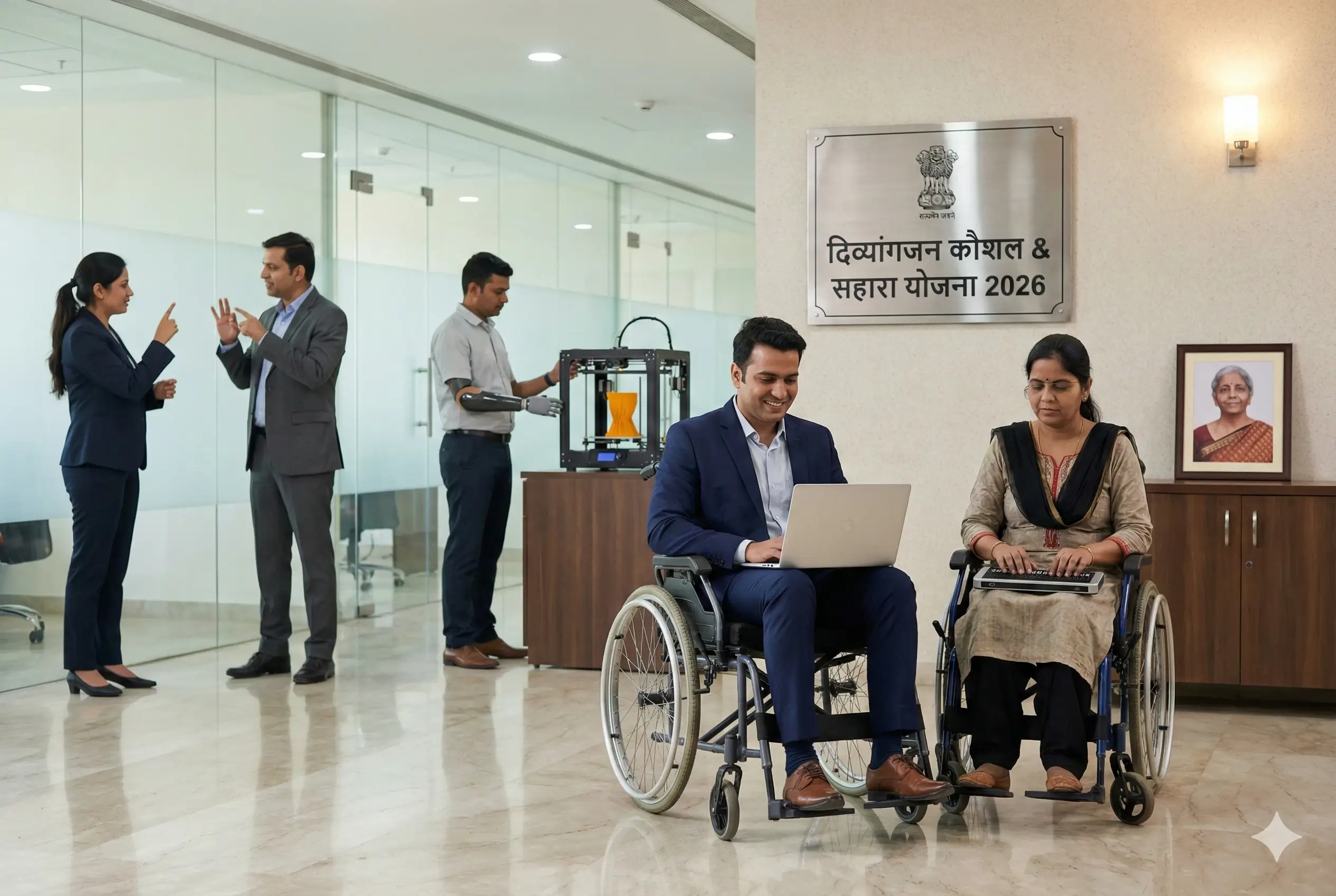
Budget 2026 Divyang Kaushal & Sahara Yojana Details
New Delhi, February 15, 2026 — Union Budget 2026-27 has brought fresh focus on persons with disabilities with the launch of two dedicated schemes: Divyangjan Kaushal Yojana and Divyang Sahara Yojana. Presented by Finance Minister Nirmala Sitharaman on February 1, these initiatives aim to bridge long-standing gaps in employment opportunities and access to quality assistive technology.
The Department of Empowerment of Persons with Disabilities (DEPwD) received ₹1,669.72 crore overall, a nearly 30 per cent increase over the previous year’s revised estimates. Of this, ₹200 crore has been set aside for the Kaushal Yojana and ₹100 crore for the Sahara Yojana.
Divyangjan Kaushal Yojana: Tailored Training for Employment
The Divyangjan Kaushal Yojana targets skill development designed specifically for different disability groups. Training will be offered in sectors such as information technology, animation, visual effects, gaming and comics (AVGC), hospitality, and food and beverage services — areas that rely on task-oriented and process-driven roles suitable for many Divyangjan.
The goal is clear: create dignified, sustainable livelihood options and help beneficiaries move towards economic independence or self-employment. Industry clusters will host the programmes to match real job demand.
Divyang Sahara Yojana: Modernising Access to Assistive Devices
Complementing the skill programme, the Divyang Sahara Yojana will strengthen production and distribution of high-quality assistive devices. The government will support the Artificial Limbs Manufacturing Corporation of India (ALIMCO) to scale up manufacturing, deepen research and development, and integrate artificial intelligence into device design.
A key feature is the establishment of Assistive Technology Marts — modern, retail-style centres where Divyangjan can view, try, and acquire devices such as prosthetic limbs, hearing aids, wheelchairs, mobility aids, and communication tools. These centres aim to make the process more user-friendly and accessible.
India’s Budget 2026 just dropped two big schemes for Divyangjan
— Sikho Ai (@SikhoAi) February 15, 2026
Divyang Kaushal Yojana → custom skill training in IT, AVGC, hospitality
Divyang Sahara Yojana → better prosthetic limbs, hearing aids + AI-powered devices
Big step toward real inclusion. 🇮🇳… pic.twitter.com/SET4QqqiqV
Broader Context of Disability Welfare
India is home to an estimated 2.68 crore persons with disabilities as per the 2011 census, though advocacy groups suggest the actual number could be significantly higher. Existing schemes like the Assistance to Disabled Persons for Purchase/Fitting of Aids and Appliances (ADIP) and Deendayal Disabled Rehabilitation Scheme continue, but the new initiatives mark a shift towards employment-linked and technology-driven support.
The Rights of Persons with Disabilities Act, 2016, mandates equal opportunities, yet unemployment and access barriers remain challenges for many Divyangjan.
Reactions from Stakeholders
Disability rights organisations have offered measured responses. Many welcomed the targeted approach, calling it a positive step towards inclusion. The National Platform for the Rights of the Disabled (NPRD), however, pointed out that overall allocations remain modest compared to need and urged clearer implementation roadmaps.
Some activists noted that while skill training and assistive devices are crucial, broader issues like accessible public infrastructure and enforcement of the four per cent job quota in government positions still require stronger action.
Eligibility and Application Process
Detailed guidelines are expected as rollout begins in 2026. Based on existing norms under DEPwD schemes, eligibility is likely to include:
- Indian citizenship
- Benchmark disability of 40 per cent or more
- Valid Unique Disability Identity (UDID) card
- Age and income criteria depending on the specific programme
Applications will probably be accepted through district social welfare offices, skill development centres, ALIMCO outlets, and upcoming online portals managed by the Ministry of Social Justice and Empowerment.
Beneficiaries can expect free or subsidised training, placement assistance, and access to modern assistive devices with financial subsidies where applicable.

A Step Forward, With More Ground to Cover
The two schemes reflect growing recognition that inclusion is not just about welfare but about enabling active participation in the economy. By combining customised skilling with technology-enabled support, the government hopes to open new pathways for millions of Divyangjan.
Implementation will be key. As states begin to roll out programmes and Assistive Technology Marts take shape, the real impact will depend on reach, quality of training, and actual placement outcomes.
For now, the Budget 2026-27 signals intent: persons with disabilities are part of India’s growth story, and targeted investment can help turn potential into opportunity.
About the Author




You can play the Mega Quizzes here 🎯
We have specially designed 120 quizzes for you to practice, test your knowledge, and improve your performance. You can access them freely using the link
Classes madi sir
Sir e yojaneya pramuka uddesha Sir