Llama 4 launched: Meta’s AI Revolution Shakes Up the Future
Experience the future of AI with Meta's Llama 4, featuring a groundbreaking mixture of experts that redefines open-source AI innovation.
- Meta released Llama 4, a new set of AI models, on April 5, 2025, including Scout, Maverick, and Behemoth.
- Research suggests Llama 4 uses a mixture of experts (MoE) architecture for efficiency, with Scout excelling in document tasks and Maverick in chat functions.
- It seems likely that Llama 4 aims to handle controversial questions more openly, addressing bias concerns, though this is debated.
- The evidence leans toward Llama 4 having licensing restrictions, especially for EU users and large companies, due to regulatory compliance.
Meta has dropped a bombshell in the AI world with the release of Llama 4, its latest collection of flagship models—Llama 4 Scout, Llama 4 Maverick, and Llama 4 Behemoth. Launched on an unexpected Saturday, this trio signals Meta’s bold response to a fiercely competitive landscape, driven by the rise of cost-efficient open models from Chinese AI lab DeepSeek. With cutting-edge architecture, massive scale, and a controversial tweak to tackle “contentious” questions, Llama 4 is poised to redefine AI’s role in everything from creative writing to STEM problem-solving. Here’s everything you need to know about this groundbreaking release.
What Is Llama 4? Meet the New AI Powerhouses
Meta’s Llama 4 family introduces three distinct models, each tailored to specific strengths and use cases. Trained on vast datasets of unlabeled text, images, and videos, these models boast “broad visual understanding,” according to Meta, making them multimodal marvels. Here’s a quick rundown:
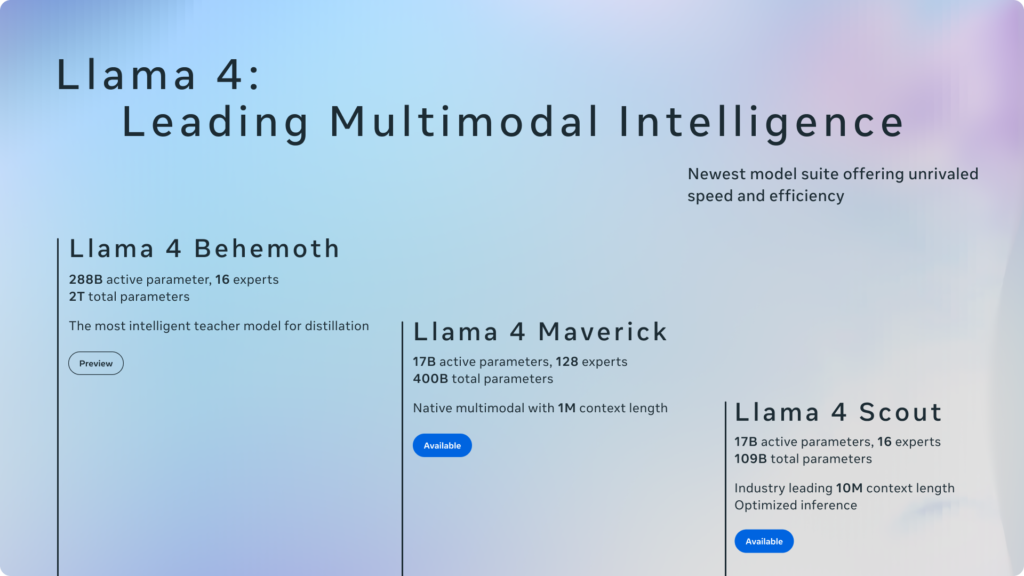
- Llama 4 Scout: A lightweight champ with a jaw-dropping 10 million token context window—perfect for summarizing lengthy documents or reasoning over massive codebases. It runs on a single Nvidia H100 GPU, making it developer-friendly.
- Llama 4 Maverick: The chat and assistant star, excelling in creative writing and multilingual tasks. With 400 billion total parameters, it competes with heavyweights like OpenAI’s GPT-4o and Google’s Gemini 2.0 in select benchmarks.
- Llama 4 Behemoth: Still in training, this beast promises unparalleled STEM prowess with nearly two trillion parameters. Early tests suggest it outshines GPT-4.5 and Claude 3.7 Sonnet in math and science challenges.
These models mark Meta’s first foray into a mixture of experts (MoE) architecture, a game-changer for efficiency and scalability. But what does that mean for users—and the AI industry at large? Let’s dive deeper.
Why Llama 4 Matters?
The timing of Llama 4’s release isn’t random. Reports indicate Meta scrambled to accelerate development after DeepSeek’s open models—like R1 and V3—matched or surpassed Meta’s previous Llama iterations while slashing deployment costs. Meta’s war rooms reportedly dissected DeepSeek’s strategies, fueling a push to reclaim its edge in the open-source AI race.
“Llama 4 marks the beginning of a new era for the Llama ecosystem,” Meta declared in a blog post. With Scout and Maverick openly available on Llama.com and platforms like Hugging Face, and Behemoth on the horizon, Meta is doubling down on accessibility albeit with some strings attached.
How Mixture of Experts Powers Llama 4
What Is MoE Architecture?
Llama 4’s standout feature is its adoption of a mixture of experts (MoE) framework. Unlike traditional models that process data uniformly, MoE breaks tasks into subtasks, assigning them to specialized “expert” sub-models. Only the relevant experts activate, slashing computational overhead while maintaining performance.
- Maverick: 400 billion total parameters, 17 billion active across 128 experts.
- Scout: 109 billion total, 17 billion active with 16 experts.
- Behemoth: Nearly 2 trillion total, 288 billion active across 16 experts.
This sparsity—activating only a fraction of parameters per task—makes Llama 4 faster and cheaper to run than monolithic models. According to IBM’s breakdown of MoE, this approach, rooted in 1990s research, is now revolutionizing large language models (LLMs) by enabling trillion-parameter scale without breaking the bank.
Performance Highlights
Meta’s internal benchmarks paint an impressive picture:
- Maverick outpaces GPT-4o and Gemini 2.0 in coding, reasoning, and image tasks but trails behind GPT-4.5, Claude 3.7 Sonnet, and Gemini 2.5 Pro.
- Scout shines in document-heavy workloads, thanks to its massive context window—think millions of words or thousands of pages processed in one go.
- Behemoth promises to dominate STEM fields, outperforming GPT-4.5 and others (except Gemini 2.5 Pro) in math and science problem-solving.
None of these models are “reasoning” AIs like OpenAI’s o1 or o3-mini, which fact-check answers for reliability but sacrifice speed. Llama 4 prioritizes efficiency and breadth over such precision, a trade-off that may shape its adoption.
Availability and Licensing: Who Can Use Llama 4?
Open Access with Caveats
Scout and Maverick are freely downloadable from Llama.com and Meta’s partners, including Hugging Face, while Behemoth remains under wraps. Meta AI, the company’s assistant across WhatsApp, Messenger, and Instagram, now leverages Llama 4 in 40 countries, though multimodal features (e.g., image processing) are U.S.-only and English-only for now.
Licensing Restrictions Stir Debate
The Llama 4 license has sparked controversy:
- EU Ban: Users and companies based in the European Union are barred from using or distributing the models, likely due to the EU’s stringent AI Act and GDPR regulations. Meta has long criticized these laws as “overly burdensome,” and this move reflects that tension.
- Big Tech Clause: Companies with over 700 million monthly active users—like Google or Microsoft—must request a special license, which Meta can approve or deny at its discretion.
Developers in the EU may feel sidelined, while large firms face uncertainty. These restrictions echo Meta’s past Llama releases, balancing open-source ethos with regulatory and commercial control.
Llama 4’s Bold Move: Tackling Controversial Questions
A Shift in Tone
Meta has fine-tuned Llama 4 to answer “contentious” questions—political and social topics its predecessors dodged. “You can count on [Llama 4] to provide helpful, factual responses without judgment,” a Meta spokesperson told TechCrunch. The models are “dramatically more balanced” in what they’ll address, aiming to avoid favoring any viewpoint.
Why Now?
This tweak comes amid accusations from figures like Elon Musk and David Sacks—close allies of President Donald Trump—that AI chatbots, including OpenAI’s ChatGPT, are “woke” and censor conservative perspectives. Musk’s xAI has struggled to eliminate bias in its own models, proving it’s a technical quagmire. Meta’s adjustment aligns with a broader industry trend: OpenAI and others are also loosening restrictions to answer more questions, especially on divisive issues.
Does Llama 4 succeed in neutrality? Bias in AI stems from training data, and perfect balance remains elusive. Still, Meta’s effort to engage rather than evade could reshape how users perceive AI trustworthiness.
How Llama 4 Stacks Up Against the Competition
Benchmark Breakdown
Here’s how Llama 4 compares to its rivals, based on Meta’s testing:
- Maverick: Beats GPT-4o and Gemini 2.0 in coding, multilingual tasks, and image processing but lags behind GPT-4.5, Claude 3.7 Sonnet, and Gemini 2.5 Pro.
- Behemoth: Outperforms GPT-4.5 and Claude 3.7 Sonnet in STEM benchmarks, falling short of Gemini 2.5 Pro.
- Scout: Unique for its 10 million token context window—no direct rival matches this for document-heavy tasks.
Hardware Demands
- Scout: Runs on a single Nvidia H100 GPU, keeping costs low.
- Maverick: Needs an Nvidia H100 DGX system or equivalent—more intensive but still manageable.
- Behemoth: Requires “beefier” hardware (details TBD), hinting at enterprise-grade infrastructure.
Llama 4’s MoE efficiency gives it an edge in scalability, but it’s not yet topping the most advanced models across all metrics. Its niche strengths—like Scout’s context window could carve out a loyal user base.
Llama 4 Models Comparison
Meta released the Llama 4 family on April 5, 2025, introducing three models: Llama 4 Scout, Llama 4 Maverick, and Llama 4 Behemoth. These models are designed to push the boundaries of AI capabilities, particularly in multimodal understanding (text, images, and video) and efficiency. They are Meta's first models to use a Mixture of Experts (MoE) architecture, which allows for more computationally efficient training and inference by activating only a subset of the model's parameters for each task.
| Specification | Llama 4 Scout | Llama 4 Maverick | Llama 4 Behemoth |
|---|---|---|---|
| Active Parameters | 17 billion | 17 billion | 288 billion |
| Total Parameters | 109 billion | 400 billion | Nearly 2 trillion |
| Experts | 16 | 128 | 16 |
| Context Window | 10 million tokens | 1 million tokens | Not specified |
| Hardware Requirement | Single Nvidia H100 GPU | Nvidia H100 DGX system or equivalent | Requires cluster-level infrastructure |
| Availability | Available on Hugging Face | Download via Llama Site | Still in training, not yet released |
Detailed Comparison
1. Architecture
All three models leverage the mixture of experts (MoE) architecture, which breaks tasks into subtasks and delegates them to specialized "experts." This enhances efficiency by activating only a fraction of the total parameters per task.
- Scout: Uses 16 experts, activating 17 billion parameters per task.
- Maverick: Employs 128 experts, also activating 17 billion parameters per task despite its larger total parameter count.
- Behemoth: Features 16 experts, activating 288 billion parameters per task, making it the most computationally intensive.
2. Performance and Use Cases
- Llama 4 Scout:
- Strengths: Excels in document summarization and reasoning over large codebases, thanks to its massive 10 million token context window.
- Performance: Outperforms models like Gemma 3, Gemini 2.0 Flash-Lite, and Mistral 3.1 on specific benchmarks.
- Ideal for: Developers needing to process extensive data or long-context tasks with limited hardware.
- Llama 4 Maverick:
- Strengths: Optimized for general assistant and chat use cases.
- Performance: Surpasses GPT-4o and Gemini 2.0 but lags behind Gemini 2.5 Pro and Claude 3.7 Sonnet.
- Ideal for: Broad applications requiring a balance of performance and accessibility.
- Llama 4 Behemoth:
- Strengths: Tailored for advanced STEM tasks such as math problem-solving.
- Performance: Exceeds several leading models but falls short of Gemini 2.5 Pro.
- Ideal for: High-end research and enterprise applications once released.
3. Efficiency and Hardware Requirements
- Scout: Runs on a single Nvidia H100 GPU.
- Maverick: Requires an Nvidia H100 DGX system or equivalent.
- Behemoth: Needs even more powerful hardware; exact specs undisclosed.
4. Context Window
- Scout: 10 million token context window.
- Maverick: 1 million token context window.
- Behemoth: Expected to be substantial.
5. Availability and Licensing
- Scout and Maverick: Freely downloadable from Llama.com and Hugging Face.
- Restrictions: Not available in the EU due to regulatory compliance.
- Special License: Required for companies with over 700M MAUs.
- Behemoth: Still in training as of April 6, 2025.
6. Handling Controversial Questions
Meta has tuned all Llama 4 models for more factual and balanced answers, addressing prior concerns of bias or censorship.
Comparison to Other Leading Models
- Maverick: Beats GPT-4o and Gemini 2.0, but behind Gemini 2.5 Pro, Claude 3.7 Sonnet, and GPT-4.5.
- Behemoth: Expected to outperform most in STEM tasks, still trails Gemini 2.5 Pro.
Architectural Innovation: Mixture of Experts (MoE)
- Efficiency: Activates a subset of parameters per task.
- Scalability: Makes training trillion-scale models feasible.
- Specialization: Allows experts to boost performance on specific tasks.
In Conclusion
Meta’s Llama 4 models cater to a wide range of use cases:
- Scout: Efficient and ideal for long-context processing.
- Maverick: Balanced general-purpose model.
- Behemoth: Cutting-edge model for advanced applications (coming soon).
Despite limitations like EU restrictions and licensing for large companies, Llama 4’s MoE architecture and performance make it a major AI contender in 2025.
What Llama 4 Means for AI’s Future?
Open-Source Leadership?
Meta’s $65 billion investment in AI infrastructure this year underscores its ambition to lead the open-source charge. Llama 4’s partial openness—tempered by EU bans and licensing hurdles—challenges the definition of “open-source.” Still, Scout and Maverick’s availability via Hugging Face fosters a vibrant developer community, potentially accelerating innovation.
Industry Ripple Effects
Llama 4’s scale (Behemoth’s two trillion parameters) and efficiency (MoE) set a new bar for AI research. Applications could span automation, creative industries, and scientific breakthroughs. Yet, regulatory pushback and bias debates will test its global adoption.
What’s Next?
Meta hints at more to come: “This is just the beginning for the Llama 4 collection.” Behemoth’s release and potential expansions could solidify Meta’s foothold in a market dominated by OpenAI, Google, and Anthropic.
Why You Should Care About Llama 4?
For developers, Llama 4 offers accessible, powerful tools—assuming you’re not in the EU or a tech giant needing a license. For businesses, its efficiency and multimodal capabilities could streamline operations, from content creation to data analysis. For AI enthusiasts, it’s a front-row seat to the next chapter of the AI race.

Ibrahim Philip 

Ibrahim Philip is a highly skilled Content Writer with a passion for simplifying complex science and technology topics. Holding a Master's degree from the University of Manchester, he crafts compelling, well-researched content at Trendsnip, making knowledge engaging and accessible to all.







About the Author





Thanks
Wow thats nice post, i understood easily. Thanks for sharing this article