Trump Suggests Relocation of Gaza’s Population Amid Controversy
Trump Indicates Relocation Could Be Temporary or Long-Term, Announces Lifting of Hold on 2,000-Pound Bombs for Israel.
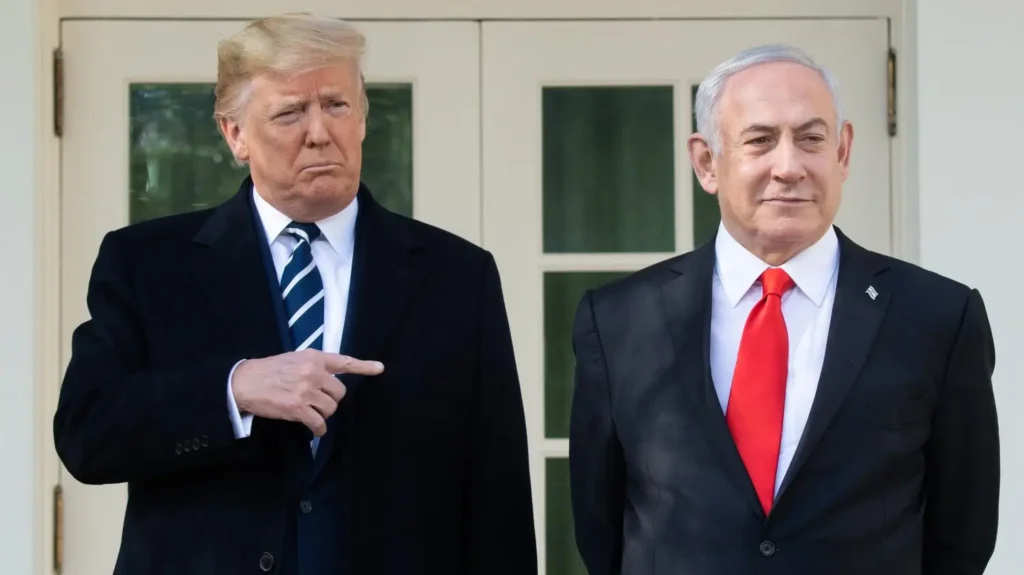
Washington, D.C. – In a recent statement aboard Air Force One, former United States President Donald Trump proposed a controversial solution to the ongoing crisis in Gaza. He suggested “cleaning out” the region and relocating its inhabitants to neighboring countries such as Egypt and Jordan. This remark has sparked widespread backlash and drawn strong criticism from various groups and leaders.
- Trump :Relocating Gaza’s Residents
Speaking to reporters, Trump revealed that he had discussed the issue with King Abdullah II of Jordan and planned to speak with Egyptian President Abdel Fattah el-Sisi. He proposed that Egypt accept displaced Palestinians from Gaza, citing the current dire situation in the region. “I would like Egypt to take people,” Trump stated. “You’re talking about probably a million and a half people, and we just clean out that whole thing and say: ‘You know, it’s over.'”
Trump acknowledged Jordan’s historical acceptance of Palestinian refugees and expressed hope that it could accommodate more. “I would love for you to take on more,” he reportedly told King Abdullah II. Referring to Gaza, Trump remarked, “It’s a real mess.”
- Humanitarian Crisis in Gaza
The ongoing conflict in Gaza has displaced nearly all of the region’s 2.3 million residents, with many forced to relocate multiple times. Trump’s suggestion to move Gaza’s population “temporarily or long-term” has reignited debates over the ethics and feasibility of such actions.
Describing the devastation in Gaza, Trump said, “It is literally a demolition site right now, almost everything is demolished, and people are dying there.” He proposed working with Arab nations to establish housing in new locations, claiming it could provide an opportunity for displaced Palestinians to “live in peace for a change.”
- International and Regional Reactions
Trump’s comments have drawn sharp criticism. The Palestinian Islamic Jihad (PIJ) condemned the proposal, labeling it as an encouragement of “war crimes.” The group stated, “This proposal falls within the framework of encouraging war crimes and crimes against humanity by forcing our people to leave their land.”
The PIJ also argued that the suggestion aligns with extreme Zionist agendas, undermining Palestinian rights and existence. They urged Egypt and Jordan to reject the plan, emphasizing that it perpetuates the denial of Palestinian sovereignty.
- Historical Context and Challenges
Abdullah Al-Arian, a history professor at Georgetown University in Qatar, emphasized that Trump’s remarks are part of a longstanding push to alter Gaza’s demographic landscape. Al-Arian noted that previous attempts to “ethnically cleanse” Palestinian territories were thwarted due to resistance from Arab leaders. He explained, “Arab leaders simply declined to take on an additional Palestinian refugee population, particularly in Egypt, where it was politically unviable.”
For Palestinians, the idea of relocation evokes painful memories of the “Nakba” or catastrophe—the mass displacement of Palestinians during Israel’s establishment in 1948. Al-Arian highlighted that Palestinians remain steadfast in their refusal to abandon their homeland, understanding the long-term consequences of displacement.
- Support from Israeli Leaders
Far-right Israeli Finance Minister Bezalel Smotrich expressed support for Trump’s proposal. “The idea of helping them find other places to start a better life is a great idea,” he stated. Smotrich added that such a plan could lead to peace and security, urging the Israeli government to develop an operational strategy to implement it.
However, critics argue that forced displacement would violate international law and exacerbate regional instability. Egypt has already warned against relocating Palestinians to the Sinai Peninsula, with President el-Sisi cautioning that such actions could jeopardize Egypt’s peace treaty with Israel.
- U.S. Military Aid to Israel
In addition to his relocation proposal, Trump announced the release of 2,000-pound bombs previously held under the Biden administration. “We released them today,” Trump said, referencing the delivery of these weapons to Israel. When questioned about the decision, he replied, “Because they bought them.”
The U.S. has historically provided substantial military aid to Israel, totaling $297 billion between 1946 and 2023, according to the U.S. Agency for International Development (USAID). This aid has fueled debates over America’s role in the ongoing conflict and its implications for Palestinian civilians.
- Path Forward
A ceasefire in Gaza, implemented a week ago, has temporarily paused the hostilities. The truce facilitated the release of some Israeli captives in exchange for Palestinian prisoners held by Israel. However, the region remains in turmoil, with international leaders divided on the best course of action.
Trump’s proposal has added a new layer of complexity to an already fraught situation. While some view it as an out-of-the-box solution, others see it as a dangerous precedent that disregards the rights and dignity of the Palestinian people. The global community continues to watch closely, seeking a resolution that balances humanitarian concerns with long-term stability.
About the Author